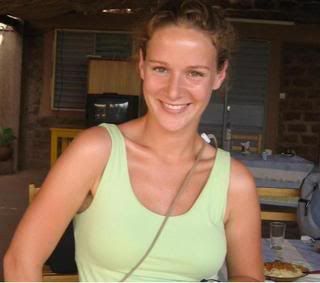
 Name: Caitlin


Meet my host sister, Saphie
The last time I saw my host sister she was hard at work picking up the leftover used plasticware off the ground. She and my host brother had accepted my invitation to come witness the ceremony where we swear-in as volunteers. We've been told it was a muted affair when compared to previous volunteer swear-ins, but from my point of view it was as ostentatious as any government funded event could be.
We arrived at the mayor's house, which when glancing at the surrounding landscpe was constructed entirely from imported material starting from the granite entrance staircase and ending with the pillared backyard terrace. We entered single file shaking very important hands or very important people whose names I will never know. Then took our assigned seats in the front.
We ran through about half dozen speakers in a rapid fire succession, raised our right hand and swore to defend the US against all enemies, evil-doers and illegal mexican immigrants. We then retired to the terrace to enjoy lunch and refreshments and reunite with our recently seperated host families. Here I found Saphie, standing with the group of village women, education and prosperity separating them from the rest, along with a basic understanding of french. We giggled through the customary Moore greetings and then I used all 10 words I knew in every combination possible before acquiesing to the inevitable awkward silence that constituted the majority of our relationship. On this occasion it was even more pronounced considering we were in public, where women's voices are muted and their opinions silenced. In Burkina there is a strict separation of public and private sphere but men have the final word in both. According to the culture and the head nurse at our health center, African women are baby machines. Their purpose is twofold; have children and raise them. Activities include and are limited to; pounding millet, drawing water from the well, washing clothes, gathering firewood, breastfeeding, cooking, cleaning, working in the fields (most likely with a baby strapped to your back). Any education is seen as a detriment to your eligibility since a man won't marry a woman with a higher education than himself. The man's family would not approve because the woman could be making decisions which would diminish the power of the man.
There are women who pursue a higher education but they are not encouraged and the odds that they pass the entrance exam are not in their favor. Their community will worry for them because they are not fulfilling their purpose according to traditional Burkina culture. This is not to say thay women who follow the customary lifestyle are necessarily miserable, inferior drones - this is where Saphie comes in. She knows a handful of french words and phrases, has one baby girl, takes a weekly trip into Ouahigouya to sell goods but spends the week partaking in the aforementioned activities in Rikou with little to distinguish one day from another. And her attitude? Laugh. With one of the biggest smiles I have yet to see she will tilt her head back and practically swallow the moon with her laugh. She takes care of 'bibata' (baby), won't hesitate to thump anyone who treats her too roughly but will be the first to scold if she starts to cry.
It's not easy growing up in Burkina. You get hurt, someone takes your food, you're scared, you start to cry and immediately you're chastised or ridiculed. If your plight was justified and your mother is at hand you could be coddled but periodically scolded if you continue to cry. If your complaint is undeserving of sympathy (the vast majority are) then you are scolded, wacked and then forgotten and left to console yourself.
But I digress, this blog is for Saphie. Saphie, who lives for her family. I once gave her a cookie (from a wonderful carepackage - thanks Ashy) and she looked at it like she didn't know what to do with it. Later, I realized she was looking for a place to keep it until she could share it with her bibata, with most skirts lacking pockets, she was momentarily confused. Everything Saphie does is for the wellbeing of her family. Family of course includes her husband, daughter, and then everyone living in the courtyard. There's alwyas work to be done in a family of 20. Even when Saphie had the flu, she was boiling water and cleaning the house, and through it all smiling, just not as big as usual. With a strictly defined role as mother, housekeeper, cook; they take their job seriously. And so we come back to the ceremony as I watch Saphie tak a sip of her Coke Cola and then put the bottle in a black plastic bag, there was no confusion this time.
We arrived at the mayor's house, which when glancing at the surrounding landscpe was constructed entirely from imported material starting from the granite entrance staircase and ending with the pillared backyard terrace. We entered single file shaking very important hands or very important people whose names I will never know. Then took our assigned seats in the front.
We ran through about half dozen speakers in a rapid fire succession, raised our right hand and swore to defend the US against all enemies, evil-doers and illegal mexican immigrants. We then retired to the terrace to enjoy lunch and refreshments and reunite with our recently seperated host families. Here I found Saphie, standing with the group of village women, education and prosperity separating them from the rest, along with a basic understanding of french. We giggled through the customary Moore greetings and then I used all 10 words I knew in every combination possible before acquiesing to the inevitable awkward silence that constituted the majority of our relationship. On this occasion it was even more pronounced considering we were in public, where women's voices are muted and their opinions silenced. In Burkina there is a strict separation of public and private sphere but men have the final word in both. According to the culture and the head nurse at our health center, African women are baby machines. Their purpose is twofold; have children and raise them. Activities include and are limited to; pounding millet, drawing water from the well, washing clothes, gathering firewood, breastfeeding, cooking, cleaning, working in the fields (most likely with a baby strapped to your back). Any education is seen as a detriment to your eligibility since a man won't marry a woman with a higher education than himself. The man's family would not approve because the woman could be making decisions which would diminish the power of the man.
There are women who pursue a higher education but they are not encouraged and the odds that they pass the entrance exam are not in their favor. Their community will worry for them because they are not fulfilling their purpose according to traditional Burkina culture. This is not to say thay women who follow the customary lifestyle are necessarily miserable, inferior drones - this is where Saphie comes in. She knows a handful of french words and phrases, has one baby girl, takes a weekly trip into Ouahigouya to sell goods but spends the week partaking in the aforementioned activities in Rikou with little to distinguish one day from another. And her attitude? Laugh. With one of the biggest smiles I have yet to see she will tilt her head back and practically swallow the moon with her laugh. She takes care of 'bibata' (baby), won't hesitate to thump anyone who treats her too roughly but will be the first to scold if she starts to cry.
It's not easy growing up in Burkina. You get hurt, someone takes your food, you're scared, you start to cry and immediately you're chastised or ridiculed. If your plight was justified and your mother is at hand you could be coddled but periodically scolded if you continue to cry. If your complaint is undeserving of sympathy (the vast majority are) then you are scolded, wacked and then forgotten and left to console yourself.
But I digress, this blog is for Saphie. Saphie, who lives for her family. I once gave her a cookie (from a wonderful carepackage - thanks Ashy) and she looked at it like she didn't know what to do with it. Later, I realized she was looking for a place to keep it until she could share it with her bibata, with most skirts lacking pockets, she was momentarily confused. Everything Saphie does is for the wellbeing of her family. Family of course includes her husband, daughter, and then everyone living in the courtyard. There's alwyas work to be done in a family of 20. Even when Saphie had the flu, she was boiling water and cleaning the house, and through it all smiling, just not as big as usual. With a strictly defined role as mother, housekeeper, cook; they take their job seriously. And so we come back to the ceremony as I watch Saphie tak a sip of her Coke Cola and then put the bottle in a black plastic bag, there was no confusion this time.
posted by Caitlin | 10:42 AM
|
1 comments
